


 Dr Prabhakar Kanade
We come across scary news items in media about milk quality describing the various harmful chemicals being added to milk or the milk itself is made using chemicals. This creates terrible fear in minds of consumers resulting in misinformed and suspicious consumer. Although the consumers always express their worry about milk quality, the consumption of milk & milk products has never seen any decline. Some traction towards nuts &/or chocolate based sweet confection has seen growth, consumers for milk-based sweets has not seen negative growth. The efforts to popularise Vegan concept couldn’t make any significant dent on market share of milk products. The reason for continued growth in milk products may be due to following reasons,
- Age old knowledge and belief that milk provides the best nutrition and is must in daily menu.
- The consumers are habitual of milk-based products and continue consumption despite underlying concerns
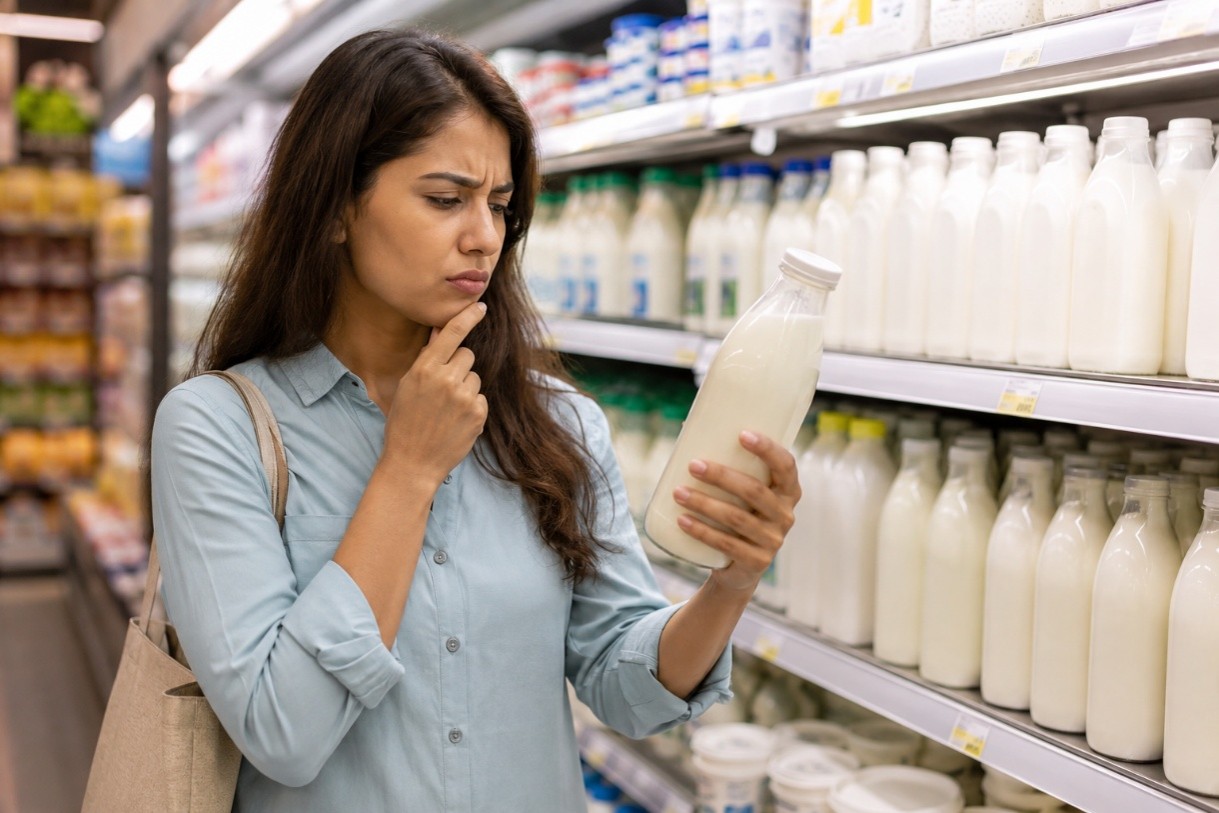
Let us understand what the most dreaded word used by the media is: ‘synthetic milk,’ which is commonly used by people as well as print and electronic media without understanding what is meant by synthetic. It is said that synthetic milk is prepared by mixing Detergent, urea and some chemicals in water to produce synthetic milk. The reality is, it is not possible to achieve a product by mixing these chemicals which can be sold or used as milk. It will fail on many counts like,
- It will not smell like milk,
- it will not taste like milk,
- it cannot be used like milk to make any product
- Nor it can be drunk like milk.
Therefore, the so-called “Synthetic Milk” does not exist.
The reality is some fraudulent milk man or traders substitute Milk Fat and MSNF partially by vegetable fat & cereal carbohydrates for economic gains. While doing this unscrupulous activity, they take help of certain chemicals like detergents, emulsifiers, urea etc. and have harmful effect on the consumers.
Let us understand the subject of milk quality concerns from basics.
According to the Food Safety and Standards Authority of India (FSSAI), food adulteration is the intentional or unintentional addition, subtraction, or substitution of substances that adversely affects the natural composition, safety, quality, or purity of food.
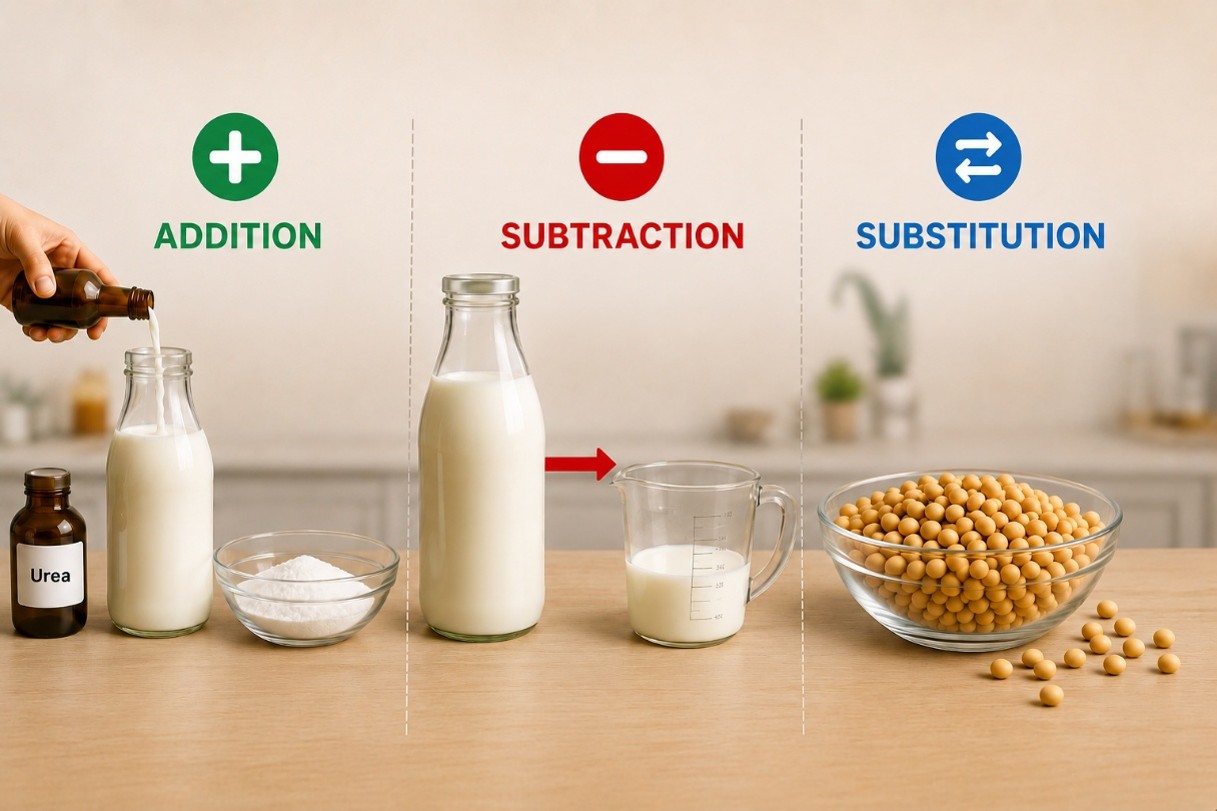
There are broadly three types of adulteration of milk depending on expected end result. However, every unlawful activity has one common goal related to economics.
- Increase shelf life
- Increase Quantity by dilution
- Substitute expensive Component as well as increase quantity
1) Increase Shelf Life:
- a) Neutralisation of increased acidity: Addition of alkali to control the increase in acidity and extend shelf life.
- b) Addition of Preservative: Formalin, Hydrogen Peroxide or antibiotics are added to milk for extending shelf life.
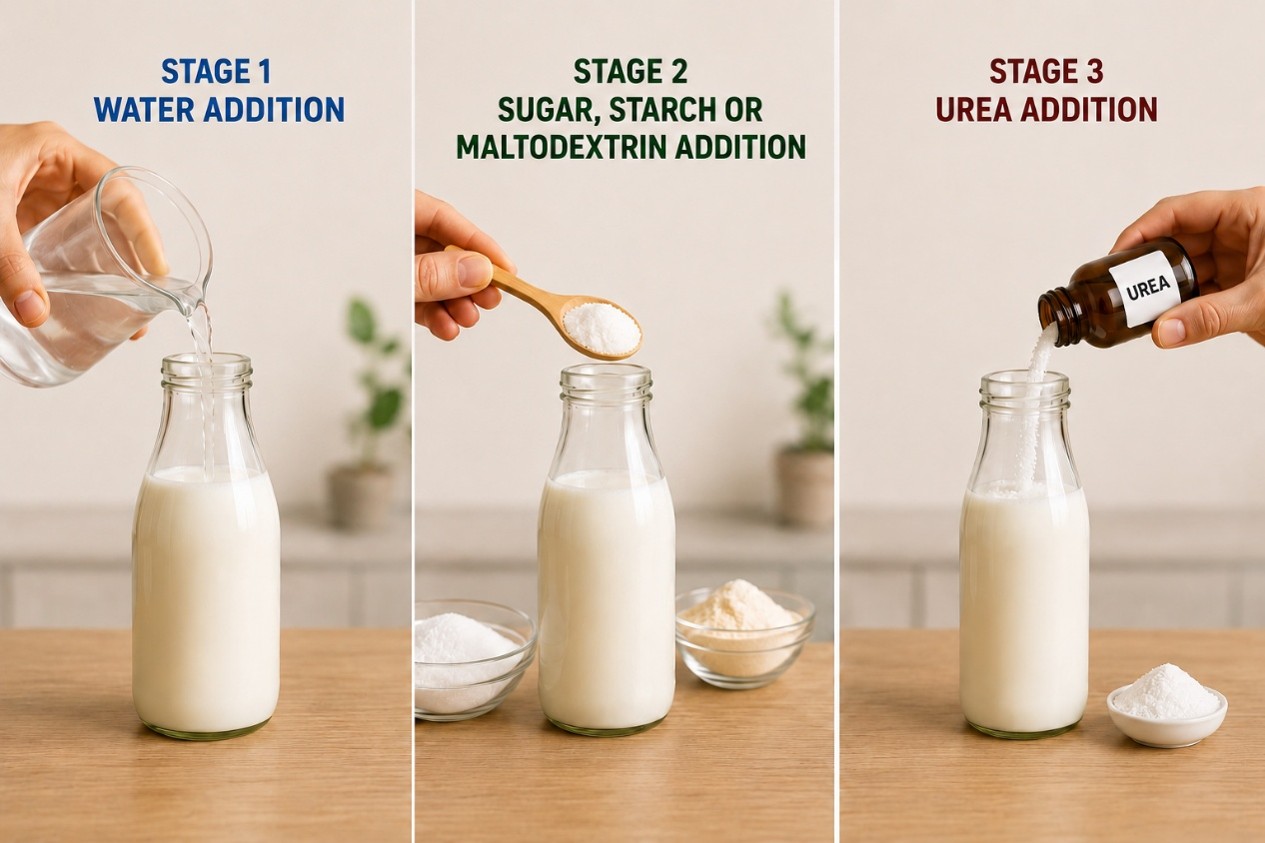
2) Increase Quantity: Addition of water to increase quantity & resulting profit
Stage 1) Water addition: Water is the most common adulterant added to milk to instantly increase volume, allowing sellers to maximize profits with zero material cost. It diminishes nutritional value, and contaminated water can introduce severe pathogens, causing diarrhoea, food poisoning, and malnutrition—particularly in infants and children who rely on milk as a primary food source.
Stage 2) Sugar, Starch or Maltodextrin addition: When milk is adulterated with water, its SNF is reduced which can identified by lab analysis and reduced thickness by consumers. Sugar, Corn or cereal starch or hydrolysed starch (Maltodextrin) is being added to adjust SNF of milk. Sugar by taste (sensory) evaluation and starch addition can be tested very easily by Iodine addition with minimum facilities at village level. However, to test Maltodextrin addition, it requires adequate lab facility with equipment, chemicals, reagents and appropriate SOP.
Stage 3) Urea addition: Substitution of SNF reduces protein in milk affecting nutritional value. In order ensure raw milk quality, reputed and large dairies test protein in incoming milk. Usually it is done by estimation of nitrogen content in milk. In order to cheat dairy, these fraudsters started adding urea to compensate for reduced nitrogen.
3) Substitution of cheap component: Addition of Vegetable Fat to increase/replace fat and generating profit many fold.
Stage 1) Farmer Level Fat addition with little detergent: Earlier years when dairy cooperatives were collecting milk from farmers at village level by only checking SNF in the village. Final price of milk to farmers was decided based on Fat quantity received by plant from particular society. Hence the individual farmer who was adding water, was going scot free but all the members of society were punished due to low fat in total milk. Last 20-25 years, dairy industry equipped Village Level Collection (VLC) centre with Fat-SNF sophisticated testing equipment. This resulted in rejection of farmer’s milk, if water adulteration was done.
In order to overcome rejection on fat basis, the farmers started adding vegetable Fat to achieve fat level along with little detergent to emulsify it.
Stage 2) Trader Level addition of Vegetable Fat with specialised chemicals with help of equipment: Post liberalisation, when dairy industry was opened to private sector and Metro cities started growing at rapid pace, milk demand increased many fold. Although milk production in India was growing rapidly due to demand, private sector taken lead in milk processing. Since they were not having milk collection network at village level, they contracted traders to collect milk for them. At this level, the milk traders sensed opportunity of making fast money by adulteration at larger scale and selling it to private dairy players who were not having milk collection system.
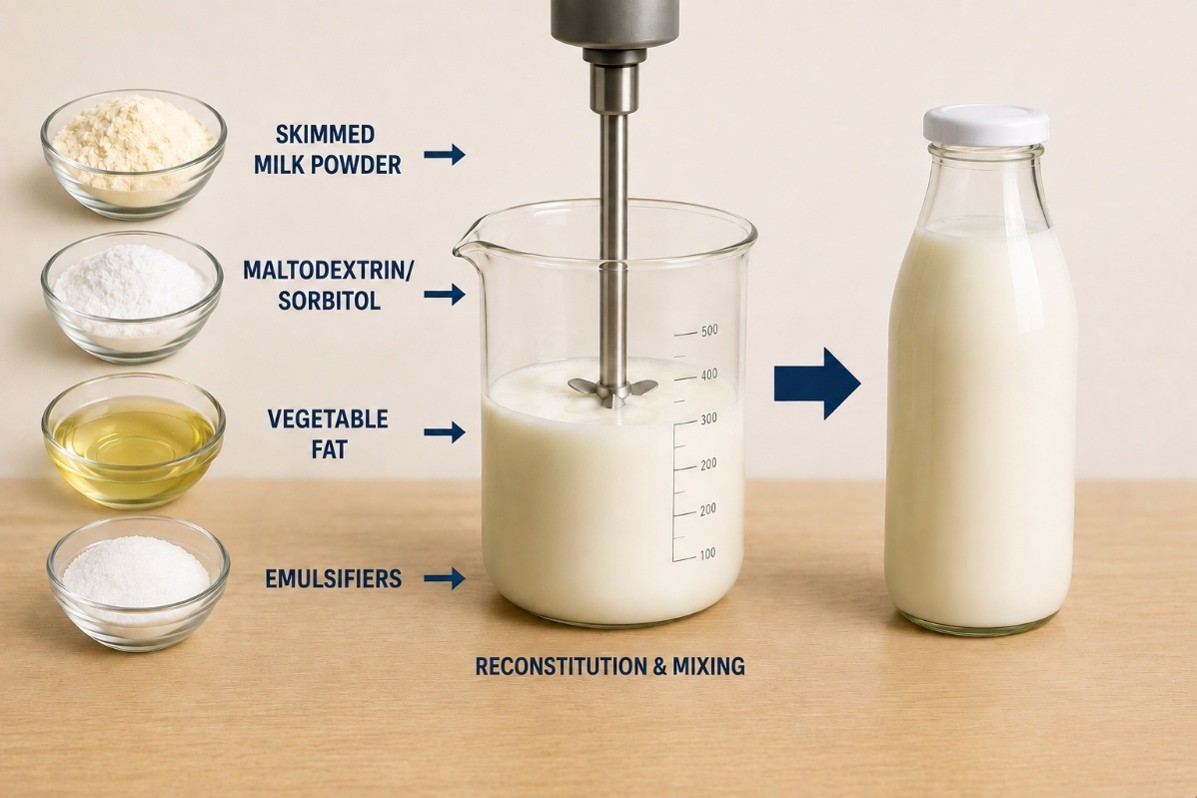
As the dairy industry tightened its testing by extensive checking of addition of Sugar, Starch, detergent and preservatives, the fraudsters started reconstituting skimmed milk powder, adding Maltodextrin/Sorbitol for SNF replacement & Vegetable fat for fat replacement along with emulsifiers.
NDDB in coordination with Mother Dairy Delhi, actively developed rapid analytical methods for quick check of quality on the receiving dock. Further a commercial kit was developed for the adulteration test and supplied to dairy plants across country at cost which became very popular as it helped small dairies to easily check adulteration. NDDB and Mother Dairy also took initiative in training small cooperatives across country to test raw milk for quality check. NDRI Karnal has also contributed and they have also developed quick quality testing methods/kits.
Today, reputed dairies in India are practising strict quality check on incoming raw milk and more than 25 tests are performed on incoming milk besides composition analysis.
Hence the reality is most of the reputable brand are taking fullest precaution to serve consumers with quality milk and milk product. However, the quality of milk supplied directly to consumers by the unorganised sector and small local players needs to be watched and regulated strictly.
How to ensure safe milk purchase:
The media reports are alarming and consumers need to be careful in selecting Milk and Milk Products vendor. The instances of milk adulteration reported in media are predominantly confined to local brands operating from small dairy units. Most packaged milk is produced by larger dairies that have adequate testing facilities to ensure food safety and quality through regular checks.
Following are the precautions
- Select a well-known brand
- Always purchase packaged Milk
- Read label information (Use by Date, FSSAI Logo & Licence Number)
- Do not buy pack having tampered seal or leakage
- If any suspicion, complain to the Manufacturer, Local Food Authority, or both.
- For Milk based Sweets, never go to unknown vendor
- Prepared food/meals containing milk product, be careful in choosing outlet
 Dr. Kejal Joshi
 Ms. Samreen Shaikh


Add comment