


 Ms. Simran Vichare
Food packaging plays a crucial role in meeting consumer demands, facilitating a wide product variety in supermarkets. Traditional packaging is often single-use, discarded after use, and while convenient, it involves significant engineering and energy. Plastics, which are non-biodegradable, contribute to approximately 150 million metric tons of waste in our oceans, with over 60% from packaging, lasting up to 400 years. A promising solution is edible packaging, which integrates the packaging into the meal, reducing landfill waste (1).
The Concept of Edible Packaging:
When selecting packaging materials, it’s crucial to consider factors like nutritional value, changes due to temperature, moisture, and oxygen, as well as mechanical impacts during shipping. Other key aspects include health and safety, cost-effectiveness, consumer habits, marketing, legislation, distribution trends, and environmental effects.
Edible packaging is created from natural, biodegradable ingredients that are safe for consumption. It is considered a sustainable option in the field of active food packaging and offers enhanced food quality compared to traditional packaging methods. The benefits of edible packaging include maintaining food quality, extending shelf life, reducing waste, and improving the economic efficiency of packaging materials. Edible packaging is emerging as one of the most practical solutions to the global plastic challenge, ranging from rice-paper containers for beverages to seaweed-based wraps for snacks. It is like a protective layer that can be eaten, formed using proteins, polysaccharides, or lipids that create films or coatings around food. Common materials used in edible packaging include:
– Seaweed and algae extracts (such as agar, carrageenan, and alginate)
– Milk proteins like casein or whey
– Plant-based biopolymers including starch, cellulose, or pectin
– Lipid-based coatings derived from waxes and oils
These materials serve as barriers to oxygen, moisture, and microbes, thereby extending shelf life while minimizing the reliance on plastic.
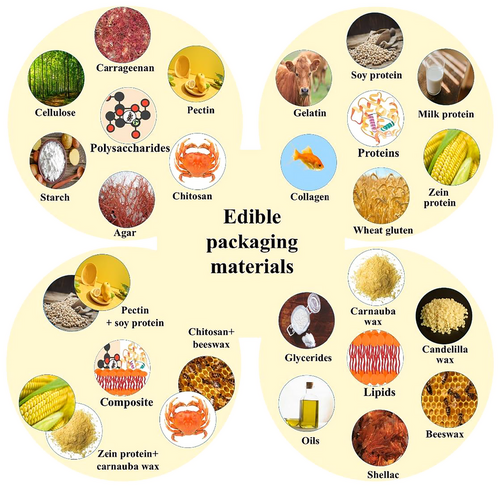
Picture credit: https://doi.org/10.1111/1541-4337.70217
Some commonly seen products are Edible straws made from sugar or starch, Edible coffee cups that do not alter the taste of drinks, Edible spoons prepared by using wheat or sorghum, Starch-based cupcake wrappers for which the main ingredient is potato starch, and Candy wrappers made from rice paper (1).

Nutrition benefits:
Edible packaging is not just for wrapping food; it can also be enhanced. From a nutrition point of view, this innovation can make way for several possibilities:
- Fortified Layers: Packaging films made with milk proteins or algae can be enriched with vitamins, minerals, antioxidants, or probiotics. Imagine a protein bar wrapped in a vitamin-infused film that boosts your nutrient intake. Edible packaging can function as a replacement and potential fortification of the layers at the outer surface of packaged products to prevent loss of moisture, aromas and ingredients
- Calorie- and Allergen-Controlled Options: Since edible coatings can be customized, they can be made low-calorie, sugar-free, or allergen-free, aligning with clean-label and health-conscious consumer trends.
- Functional Ingredients: Seaweed-based films naturally contain fibre, iodine, and polyphenols, while protein-based coatings can add amino acids and bioactive peptides, subtly enhancing the nutritional profile of the food they protect (2).
Industry Applications on the Rise
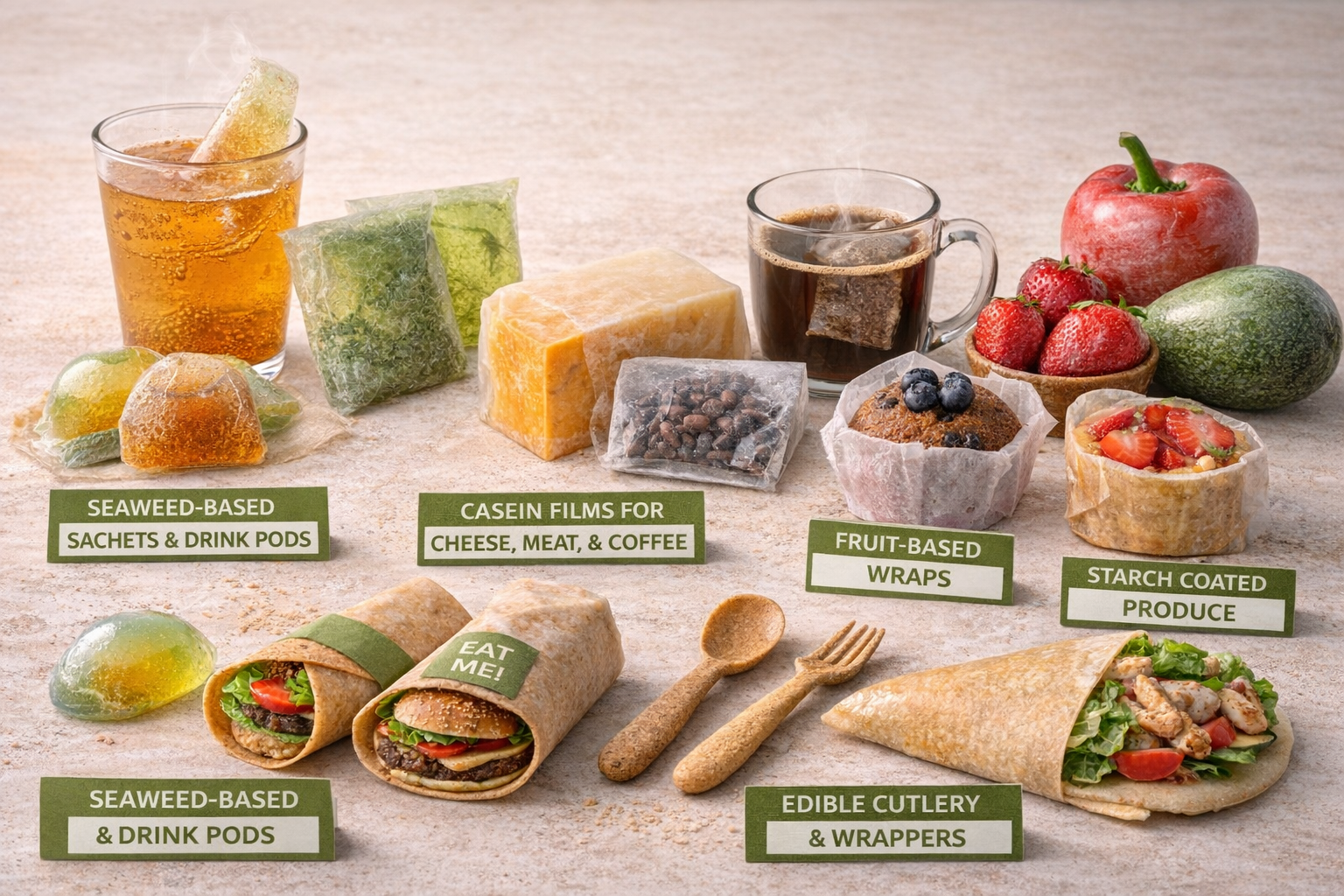
The food industry is exploring innovative solutions in edible packaging, particularly within the ready-to-eat, snack, and beverage sectors. Like seaweed-based sachets and drink pods. Casein films are being utilized for packaging cheese, meat, and coffee products, designed to dissolve in hot water for easy disposal. Fruit-based wraps are emerging as a popular choice for confectionery and bakery items, while starch coatings applied to produce help slow down ripening and minimize waste. Complementing these developments, food delivery platforms and quick-service restaurants (QSRs) are also investigating the use of edible cutlery and wrappers as part of their broader sustainability initiatives, aiming to reduce environmental impact while enhancing the consumer experience.
Incorporation Techniques for Antimicrobial Agents: (3)
Conventional methods for applying antimicrobial solutions, such as spraying or dipping, often prove ineffective. This is primarily because compounds like essential oils and bacteriocins can degrade due to enzymes present on food surfaces, or they may migrate into the food, which not only diminishes their effectiveness but can also alter the sensory properties of the final product. Edible films and coatings address these challenges by providing a controlled environment for the diffusion and gradual release of antimicrobial agents. This approach not only extends shelf life but also preserves the quality of the food.
There are two primary methods for incorporating antimicrobial agents into these films: direct and indirect incorporation.
- In direct incorporation, antimicrobials are blended into edible polymers via techniques such as solution casting, coating/immersion, and melt extrusion. Each technique involves optimizing parameters, like concentration, mixing, temperature, and drying conditions, to achieve uniform films that effectively inhibit microbial growth. Solution casting is straightforward and frequently used, while coating is well-suited for food items with irregular shapes. Melt extrusion supports continuous, large-scale production, making it ideal for commercial applications.
- Indirect incorporation/ encapsulation offers additional advantages by encasing antimicrobial agents within micro-, nano-, or cyclodextrin-based shells. This not only enhances the stability and controlled release of the agents but also improves their bioavailability and prevents interactions that could compromise their potency. Microencapsulation and nanoencapsulation are particularly effective, with nanoencapsulation providing even greater efficiency due to its larger surface area, which facilitates better release dynamics. Nanotechnology is enabling the novel development of nanoscale edible coatings which could be used for packaging meats, cheese, fruit, vegetables, confectionery, bakery goods, and fast-food products. The advantage of nanoscale edible coatings is that they provide a moisture barrier and control gaseous exchange. At the same time, nano-coatings can act as a vehicle to deliver colours, flavours, antioxidants, enzymes and anti-browning agents, etc
Inclusion complexes utilizing cyclodextrins are also noteworthy, as they encapsulate hydrophobic antimicrobials to enhance solubility, minimize volatilization, and ensure a steady release rate. Overall, these innovative incorporation techniques lead to the development of more effective antimicrobial packaging systems. These systems not only safeguard food safety but also extend shelf life and maintain the sensory qualities of perishable foods, enhancing consumer satisfaction and reducing waste.
Challenges and Considerations
Consumer acceptance remains a significant hurdle, as people are hesitant about the concept of “eating the wrapper,” highlighting the importance of transparent safety and hygiene standards. Safety and regulatory considerations for edible antimicrobial packaging require that all polymers and antimicrobial agents be non-toxic, food-grade, and free from major allergens unless clearly labelled. Thorough toxicity and allergen assessments must be completed before commercialization. The packaging should not alter the sensory or nutritional quality of food, and interactions between food and active agents must be evaluated. Life-cycle analysis is also important to assess sustainability versus conventional packaging. Nanoencapsulation offers controlled release but raises concerns about nanoparticle migration, bioaccumulation, and human exposure, requiring detailed risk assessment, studies, and transparent labelling of nanoparticle characteristics and regulatory approval status.
Edible packaging provides limited protection for food compared to conventional plastic. It is generally fragile and offers low to moderate resistance to impact, making it suitable mainly for dry, low-risk foods or as an inner layer. While some edible materials can act as moderate barriers to oxygen and fats, their moisture-barrier properties are often weak unless combined with lipids. Microbial protection can be improved with natural antimicrobial agents, but edible packaging cannot replace hygienic processing or ensure complete safety (6). Washing edible packages is impractical as it may damage them and increase contamination risk, similar to the nutrient loss seen when washing rice. Designed for cleanliness through controlled manufacturing and handling, edible packaging can be printed on with food-grade inks, though print quality is limited compared to plastic. Overall, it offers partial protection and environmental benefits but requires careful design and handling for safety and effectiveness.
The shelf stability of edible films can be compromised by factors such as humidity and temperature, which can adversely affect their texture and structural integrity. Regulatory frameworks are also in a state of evolution globally, with clear labelling and safety approvals still developing. Furthermore, the production costs of edible packaging currently exceed those of plastic by 30-50%, though ongoing innovation and scaling efforts are working to reduce this disparity (5).
Conclusion
Edible packaging is a sign of the food industry’s evolution toward integrated sustainability that nourishes both people and the planet. As innovation accelerates, edible films are evolving to include smart indicators, functional nutrients, and controlled-release antimicrobial systems. This enables brands to find creative ways of offering new CPG (Consumer Packaged Goods) packaging that’s good for the environment, provides nutritional benefits to consumers through plant-based ingredients, and promotes future design innovation.
The edible packaging market is projected to grow at a compound annual growth rate (CAGR) of 5.6% from 2023 to 2030 (4). In addition to being sustainable, this substitute has the potential to completely transform packaging in a variety of sectors, including food, drink, cosmetics, and pharmaceuticals.
References-
- https://www.pkgbranding.com/blog/examples-of-edible-packaging
- https://www.sciencedirect.com/science/article/abs/pii/S0963996920310061
- https://ift.onlinelibrary.wiley.com/doi/10.1111/1541-4337.70217
- https://thecsruniverse.com/articles/edible-packaging-the-future-of-sustainable-solutions-in-the-battle-against-plastic-waste
- https://www.24chemicalresearch.com/reports/148212/edible-packaging-market
- https://journalejnfs.com/index.php/EJNFS/article/view/1715/3634

 Ms. Sanyukta Telange

 Dr Jagadish Pai


Add comment